


Choosing an architect

Clients often approach us with only an outline idea of their project – for example they need more space or feel there is a disconnect between their house and garden – and can’t see how best to find a solution. They feel a need for architectural insight and advice to bring a project to life; This is where we begin to add significant value. We help our clients to explore and refine their needs before responding with concept designs, often introducing ideas beyond what they had imagined possible. Not only does this help both parties ensure they are on the right path to a viable solution, but also that the solution has an expert’s insight to make an elegant proposal that gets the absolute maximum benefit for the money spent.
North Road – Submitted for Planning

We are delighted to have submitted a planning application for a development in North Road, Bath. The development will include three houses, which are designed to have four bedrooms over three floors, including the attic.
Project Updates!

Although these are two very different projects, both demonstrate Designscape’s approach to design. We prefer not to limit ourselves by project type, rather to bring our considerable experience to each brief afresh.
Little Court – Progress update

Little Court construction is progressing rapidly towards completion in early September. The walls are up, the roof is on and the windows are in. The contractor is getting finishes underway
Park House A contemporary new house using traditional materials.
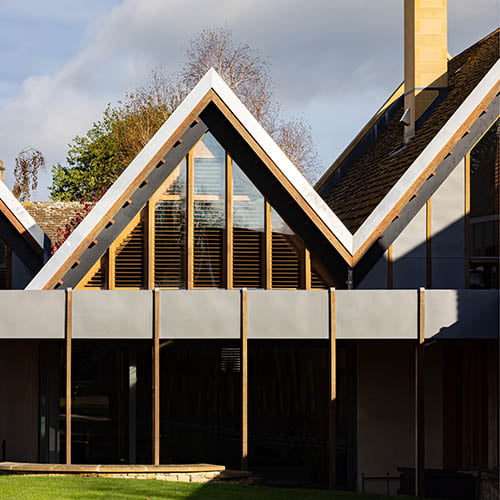
This new family home is a replacement dwelling in the Greenbelt, replacing an unremarkable series of existing buildings which occupied a prominent corner in the village Conservation area. The challenge was to design a building which responds positively to the village context, respecting the defining characteristics of the village, whilst at the same time creating an uncompromised contemporary piece of architecture, responding positively to its physical and its social context. The proposal retains one small fragment of the existing buildings which was originally a public “Reading Room” built in 1885 “for the use of men and boys of the village”. The design responds to the public realm with a series of steep (50deg) pitched gables with stone copings – familiar forms and materials, but with non-traditional detailing around openings. On the other side it responds to the private gardens with a much more open and transparent façade, connecting the living spaces to the garden and open countryside beyond. The dominant material is the Cotswold stone roof which unifies the whole composition, the glass and metal panels of the private side provide a counterpoint, which emerge subtly in the detailing around the openings, and in the staircase “turret” which provides a lookout from the private interior to the public realm. The house design has comfortably exceeded the requirements of Code for Sustainable Homes (Level 4), primarily through the use of simple passive energy design principles, but will go further still by the use of various active energy technologies.
Avonbridge House A Headquarters in a Listed factory building
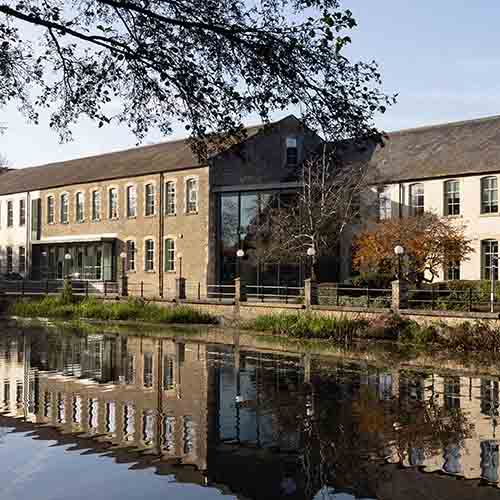
Avonbridge House is a Listed building, formerly a Milk Condensery, the first such building in the country; operated by Nestle until the 1960’s. Converted to offices in the 1980’s the building is now wholly occupied by Alliance Pharmaceuticals as their Global HQ. Working with long term interior design and space planning collaborators Wylde IA, Designscape have obtained a number of Listed Building Consents to replace elements of the 1980’s conversion and extend office accommodation for this growing business in a series of phases. This includes converting un-used attic into office space; new reception area, replacement curtain walling and windows, external breakout terrace, the replacement of roof slates and installation of roof lights and PV Solar panels.
Interior design and space planning Wylde IA.
The Project was awarded a Chippenham Civic Society Conservation and Environment Award in 2022.
Designscape is open for business

In line with current UK Government recommendations to protect the health of our staff and others, we have instituted measures to enable us to work remotely and continue to provide our high quality and collaborative service.
Freshford SchoolProposal for a School Expansion

Designscape Architects prepared a feasibility report for the expansion of the school
accommodation. Despite being a rural school, it has no onsite playing field and only five
classrooms, but seven year groups. The school had the possibility of acquiring some
adjacent land as a playing field and needed to explore the potential in future of adding
two classrooms.
Our proposal succeeded to link the new playing field via an amphitheatre outdoor area,
and replaced the playground space given over to the classrooms with an elevated play-
deck on the classroom roofs, linking with existing first floor classrooms. The proposal
also sought to address other issues such as access and security and proposed some
ideas for parking and pick–up space.
Science Museum, Wroughton A sustainable Museum Archive
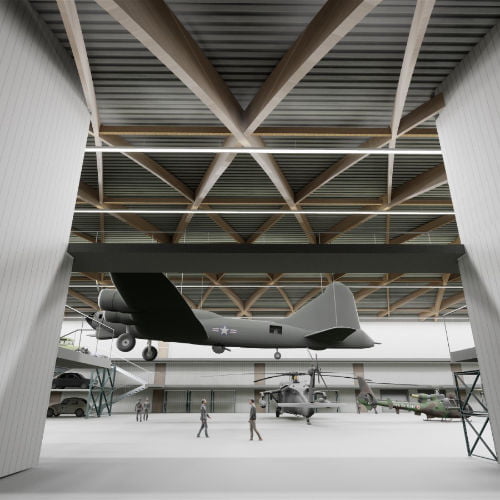
We were invited by the Science Museum to submit proposals for a new archive store on a former airfield at Wroughton, near Swindon to accommodate a large and varied collection of museum artefacts currently stored in London. These museum objects vary from small objects such as books to large vehicles and even planes. Many are being kept for historic purposes, but are rarely if ever displayed, only a few are stored temporarily, visitors are by special appointment only. A low maintenance, low energy, long life building solution is required. Stable temperature conditions and low humidity are required. A design which minimises risk of water ingress is essential as is a low cost solution. Our proposal was for a super-efficient, wide span timber arch structure capable of supporting heavy loads and creating flexible internal space. The absence of walls avoids junctions for potential leaks and reduces building wind loading. Heavy mass helps create a stable internal climate, with little energy load.
Science Studios Art gallery, production and storage building.
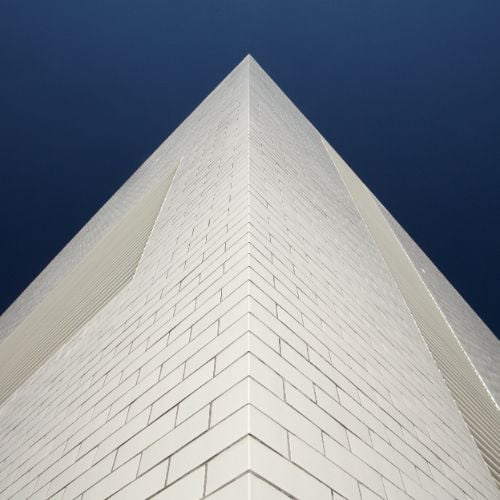
Designscape has developed a 9,000sqm art production studio and gallery for Damien Hirst. The project reuses an existing steel portal frame structure originally built for the manufacture of plastics. The brief involved a high level of design, detail and finish, including exceptionally high structural loading requirements and innovative cladding and glazing. The building is split into three bays: reception and gallery, art production and storage facilities, with each area defined externally through cladding panels of contrasting colours. The artist’s production of large-scale art work requires highly specialised accommodation, including freezer storage and a fire protected art store. The western riverside boundary has become a sculpture garden.
In addition to the principal Science gallery and production space, a smaller independent formaldehyde studio has been built. The formaldehyde studio requires unique accommodation and dedicated services, including specialist ventilation equipment to filter out the formaldehyde fumes. As well as large-scale freezer storage, specialist cranage equipment has been incorporated for handling large and delicate art works. The steel frame structure is clad with white glazed bricks and small mortar joints to create a sculptural monolithic appearance.
In association with MRJ Rundell + Associates